

Details:
Customer
Aristotle University of Thessaloniki
Technology Used
Ansys Q3D and HFSS
The Institute:
The Aristotle University of Thessaloniki is the largest university in Northern Greece.
The project:
At the core of this technology are Through Silicon Vias (TSVs), which act as vertical electrical connections between layers. Accurately predicting their electrical behavior, especially at high frequencies up to 50 GHz, is often a challenge.
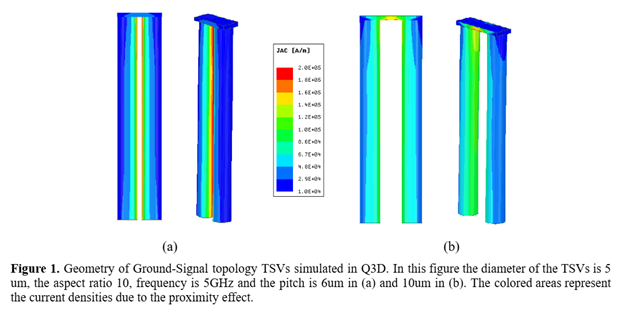
The behavior of TSVs is mainly defined by their resistance and inductance, which directly impact signal integrity. While these parameters are relatively easy to estimate at lower frequencies, things change significantly at higher frequencies due to physical phenomena such as the skin effect and the proximity effect. The skin effect forces current to flow near the surface of the conductor, while the proximity effect causes nearby conductors to influence how current distributes inside a TSV (Figure 1). These effects lead to higher losses and can dramatically alter performance, particularly in dense TSV structures.
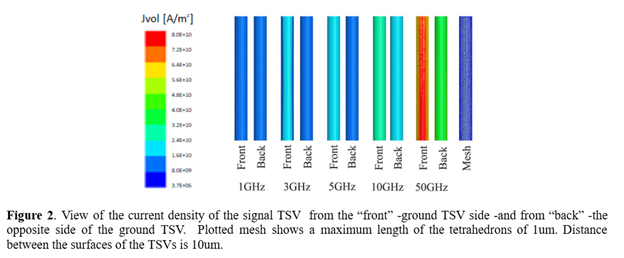
Traditional modeling approaches often fall short because they simplify or completely ignore how the proximity effect changes with frequency. When using advanced electromagnetic simulation tools like Ansys HFSS (Figure 2), engineers need additional steps to extract meaningful quantities such as resistance and inductance.
A more effective approach combines simulation accuracy with analytical efficiency. By using Ansys Q3D Extractor, engineers can directly compute resistance and inductance and use these results to enhance classical models. In this work, a well-known Transmission Line Model was improved by fitting it to detailed simulation data. The key innovation is the introduction of a frequency-dependent proximity effect, allowing the model to reflect how current behavior evolves as frequency increases.
The simulations reveal important insights that are difficult to capture with traditional methods. As frequency rises, current tends to crowd on the side of a TSV facing its neighboring conductor. This effect becomes more pronounced at higher frequencies, leading to a significant increase in resistance—up to 50% in some cases. In dense TSV arrays, the impact is even more dramatic, with resistance increasing by more than ten times compared to an isolated TSV. At the same time, inductance decreases because the current is confined to smaller regions within the conductor.
Modern chip design increasingly depends on understanding complex physical effects that are not visible at first glance. Tools like Ansys Q3D Extractor and Ansys HFSS make these effects measurable and manageable, enabling better design decisions early in the process.
This work has been published by Vasileios Gerakis, Alkis Hatzopoulos, “Improved Transmission Line Model for High Frequency Modelling of Through Silicon Vias”, International Journal of Electronics, 2019 (link).