


Details:
Customer
Aristotle University of Thessaloniki
Technology Used
Ansys HFSS
The Institute:
The Aristotle University of Thessaloniki is the largest university in Northern Greece.
The project:
Guided by the long-standing trend described by Moore’s Law, modern CMOS technologies now enable operation well into the millimeter-wave (mmWave) range, approaching 100 GHz. While this progression allows for faster data processing and communication, it also introduces new physical effects that challenge conventional design assumptions.
One of the most critical challenges at these frequencies is electromagnetics coupling through the silicon substrate of the chip. At mmWave frequencies, the substrate becomes a path through which electromagnetic signals can propagate. This leads to increased crosstalk between on-chip components.
To investigate these effects, electromagnetic simulations were conducted using Ansys HFSS. Such tools are essential in modern design workflows, as they allow engineers to accurately model complex electromagnetic interactions that cannot be captured by simplified analytical approaches.
The study focused on integrated inductors, which are fundamental components in radio-frequency circuits. Due to their operating principle, inductors generate strong electromagnetic fields and are therefore particularly susceptible to substrate interactions. The simulations demonstrated that substrate coupling can increase dramatically up to 400% under certain frequency and distance conditions. Additionally, the presence of the substrate was found to degrade the inductor’s quality (Q), directly impacting circuit performance. These results also revealed that traditional compact models are insufficient at mmWave frequencies, necessitating more advanced modeling approaches to accurately capture device behavior.
The study also evaluated commonly used isolation techniques. Guard rings, which are conductive structures placed around sensitive components, were shown to significantly reduce coupling. In particular, octagonal metal guard rings provided the most effective solution, achieving substantial crosstalk attenuation while also improving the quality factor of the inductors. However, this improvement comes at the expense of increased silicon area, illustrating the trade-offs inherent in high-frequency design.
Shielding techniques were also investigated. Planar metal shields placed beneath inductors can effectively block electromagnetic fields from penetrating the substrate. Among the configurations studied, solid grounded shields offered the highest level of isolation.
The interaction between electromagnetic fields and the substrate becomes a dominant factor, influencing both signal integrity and component performance. As a result, accurate simulation and careful optimization are essential at the early stages of the design process. Tools such as Ansys HFSS play a crucial role in enabling engineers to address these challenges and design reliable, high-performance circuits for next-generation applications.
This work was published by CRC press as a book chapter: T. Noulis (Editor), “Noise Coupling in System-on-Chip”, CRC Press, 2017 (Vasileios Gerakis, Alkis Hatzopoulos, “Coupling through substrate for millimeter wave frequencies”) (link)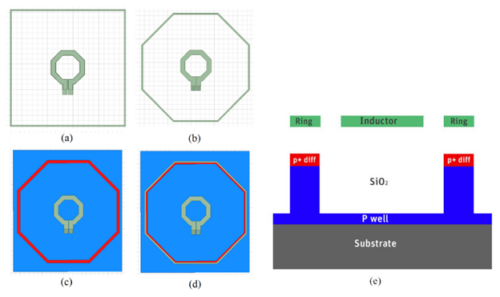
Figure 1. Various geometries of guard rings. Green color is the highest metal layer, where the inductors and the rings lie, blue is the is p-well and red is the p+ diffusion paths than create the p+ rings (a) square metal ring, (b) octagonal metal ring, (c) octagonal p+ ring, (d) both metal and p+ octagonal rings, far from the inductor. (e) Intersection of the (d) layout.