

Details:
Technologies Used
- Ansys Fluent
- PyFluent
- Python
Objective:
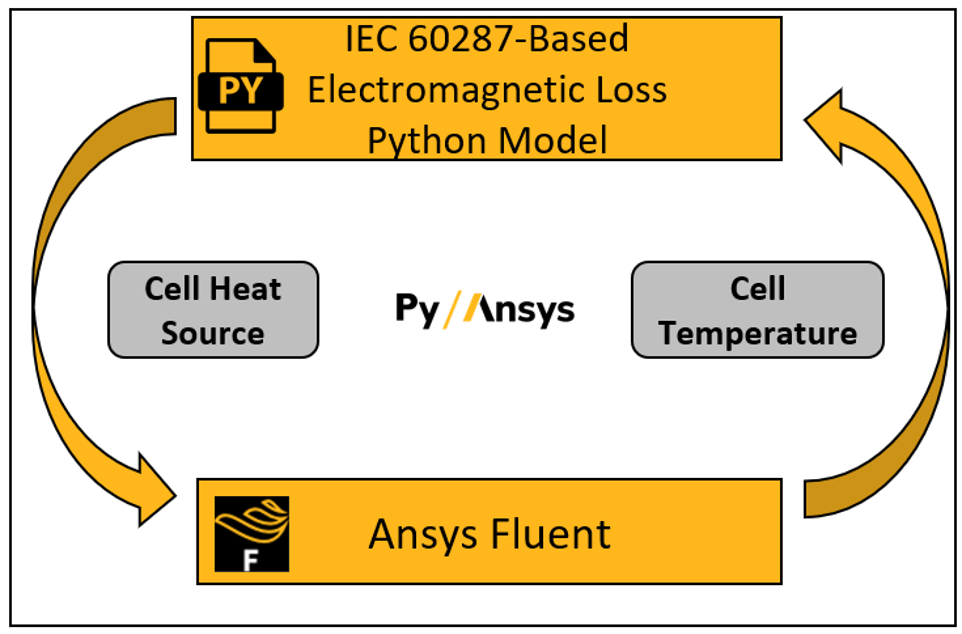
Develop a high-fidelity electromagnetic-thermal co-simulation framework for power cables that accounts for local temperature variations, enabling accurate calculation of temperature-dependent electromagnetic losses with fully distributed, mesh-resolved heat sources.
Challenge:
IEC 60287-based methods assume uniform conductor and sheath temperatures, which can be inaccurate when strong thermal gradients, magnetic armor, proximity effects, or circulating currents exist. Electromagnetic losses depend nonlinearly on local temperature through conductivity and permeability, requiring a stable method to couple detailed electromagnetic models with spatially resolved CFD thermal fields for reliable cable thermal ratings.
Solution:
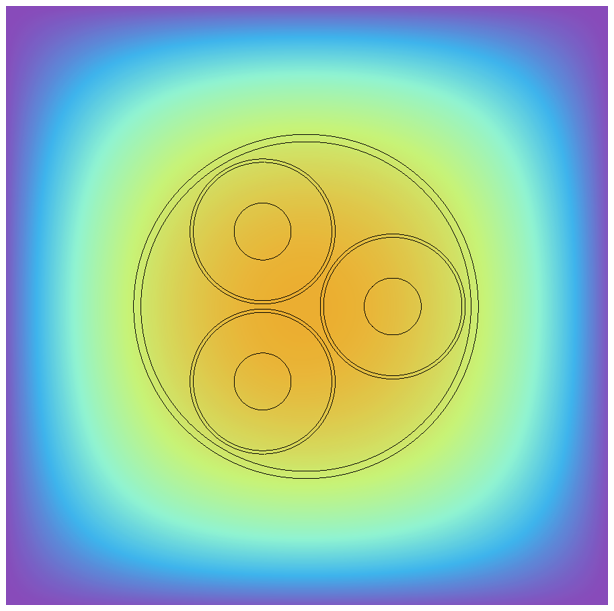
An extended IEC 60287-based electromagnetic loss model, including sheath and magnetic armor contributions, was integrated with Ansys Fluent via PyFluent. The workflow retrieves local temperatures for each mesh cell within cable zones in Fluent, evaluates temperature-dependent electromagnetic properties per cell, and computes volumetric heat sources as explicit functions of local temperature. These distributed sources are then applied back to Fluent to resolve the thermal field with full geometric and material fidelity. The resulting two-way, cell-resolved coupling ensures consistent, accurate interaction between electromagnetic losses and thermal fields, capturing detailed cable behavior under operational conditions.
Conclusion:
The fully two-way coupled, cell-resolved approach demonstrated excellent agreement with validated Fluent results, with no observable deviation from reference solutions. By accounting for local temperature variations and correctly distributing electromagnetic losses at the mesh level, this method significantly improves accuracy over lumped and one-way approaches, providing a robust framework for high-precision thermal rating and performance assessment of complex power cables.